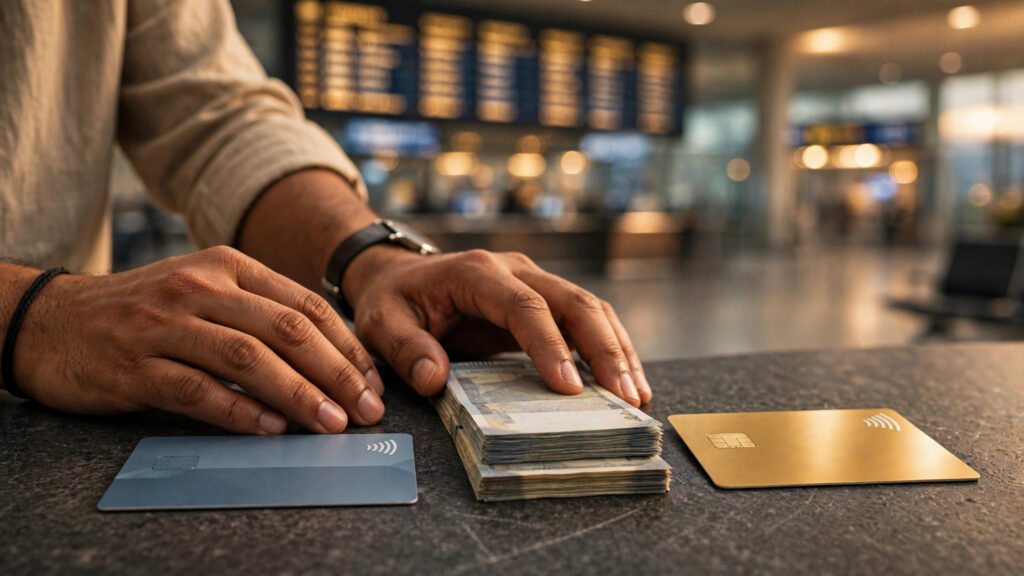
Every Indian going abroad faces the same question at the money changer: should I carry a forex card vs cash vs credit card? The wrong choice can quietly cost you thousands of rupees in markups and fees — and the right choice depends on where you are going and how you spend. This guide compares all three honestly so you can decide like a smart traveller.
What Each Option Actually Is
- Forex card (prepaid travel card): Loaded with foreign currency before travelling, at a locked-in rate. Issued by banks and authorised dealers.
- Cash (foreign currency notes): Physical currency bought from a money changer or bank before departure.
- Credit card (international-enabled): Your regular Indian credit card used abroad — the bank converts each transaction and adds a markup.
None of the three is “best” for everything. Most experienced travellers use a combination.
Forex Card vs Cash vs Credit Card: Cost Comparison
| Factor | Forex Card | Cash | Credit Card |
|---|---|---|---|
| Exchange rate lock | Yes — rate fixed when you load | Yes — rate fixed when you buy | No — rate at transaction date |
| Markup on rate | Generally low (check the dealer’s spread) | Varies by dealer; airport counters are costly | Foreign-currency markup typically 1–3.5% per transaction |
| ATM withdrawals abroad | Usually a flat fee per withdrawal | Not applicable | Cash advance fees are very high — avoid |
| Reloading abroad | Possible via app/netbanking | Impossible — what you carry is what you have | No loading needed |
| Interest risk | None (prepaid) | None | High if you don’t pay the bill in full |
Key insight: Credit cards are convenient, but the per-transaction markup plus the “pay in INR” trap (when a merchant offers to bill you in rupees — always decline and pay in local currency) make them the most expensive way to spend abroad. Use credit cards for hotel deposits and emergencies, not daily spending.
Safety and Practicality
- Cash rules in small shops, local markets, taxis and street food — but lost cash is gone forever. Never carry your whole trip budget in cash.
- Forex cards can be blocked and replaced if lost, and most have an app to track spending. But some small merchants don’t take cards, and network outages happen.
- Credit cards offer the best fraud protection and are essential for car rentals and hotel security deposits, which often require one specifically.
A practical split for a typical 5–7 day trip: 60–70% on a forex card, 20–30% cash in local currency, credit card as backup for deposits and emergencies.
7 Smart Rules for Travel Money
- Buy currency before you fly — airport counters almost always give worse rates than city dealers.
- Compare the total cost, not just the advertised rate — ask about every fee and the exact INR debit.
- Load the card in the currency you’ll spend — loading the wrong wallet costs conversion fees.
- Carry some USD or EUR as backup cash — exchangeable everywhere, even in non-dollar destinations.
- Never accept “pay in INR” abroad — always pay in the local currency.
- Inform your bank of travel dates so cards aren’t blocked for “suspicious” foreign transactions.
- Save your card issuer’s international helpline in your phone, not just in your wallet.
Forex Card vs Cash vs Credit Card: The Final Verdict
For daily spending abroad, a forex card usually wins — locked rates, low markups, replaceable if lost. Cash is essential where cards aren’t taken. Credit cards are for deposits, bookings and emergencies. Mix all three, lean on the forex card, and you’ll spend less and stress less.
See how budgeting works on real itineraries: our Singapore–Malaysia combo package guide and Fiji 6-day package guide. And don’t skip travel insurance — it protects the money you can’t plan for.
Frequently Asked Questions
Q1. How much foreign cash can I carry from India?
A. As per RBI’s Liberalised Remittance Scheme limits — check the latest RBI guidelines before your trip, as limits change.
Q2. Is a forex card accepted everywhere?
A. At most places that accept Visa/Mastercard, yes. But always keep some cash for small vendors, local transport and tips.
Q3. Can I convert leftover foreign currency back to INR?
A. Yes — authorised dealers buy back unused currency, though at a slightly lower rate. Forex cards can also be encashed after your trip.
Q4. Should I use my debit card abroad instead?
A. It works, but foreign ATM and transaction markups are generally higher than forex cards. Compare your bank’s charges first.
Q5. What if my forex card is lost abroad?
A. Block it immediately through the issuer’s app or international helpline, and request a replacement — your loaded balance is protected, unlike lost cash.
📞 Sunlight Holidays se baat karein
Visa, tour package ya videsh job se judi kisi bhi jaankari ke liye WhatsApp karein: 9720 3449 39
💰 Payment After Reach model — bhaari advance nahi, pehle bharosa.
📝 Consultation/Application fee: ₹799 (non-refundable, kaam shuru hone ke baad)
⚠️ Disclaimer: Sunlight Holidays ek travel consultancy hai — hum sarkar, embassy ya immigration department nahi hain. Visa approval, fees, processing time aur final faisla sambandhit embassy/sarkari authority ka hota hai. Kripya antim nirnay se pehle official embassy/government website se latest jaankari verify zaroor karein.