


Iran War Impact: Middle East Travel & Tourism Industry Losing $600 Million Per Day – Full Detailed Analysis
Introduction
The ongoing geopolitical tensions involving Iran have triggered a massive economic ripple effect across the global travel and tourism sector, particularly in the Middle East. According to recent reports and industry estimates, the region is currently facing a staggering loss of approximately $600 million per day due to disruptions caused by the conflict.
This situation is not just a regional concern but a global economic issue, affecting airlines, hotels, travel agencies, and millions of travelers worldwide. The Middle East, which has long been a central hub for international travel and transit, is now experiencing one of its most challenging periods in recent years.
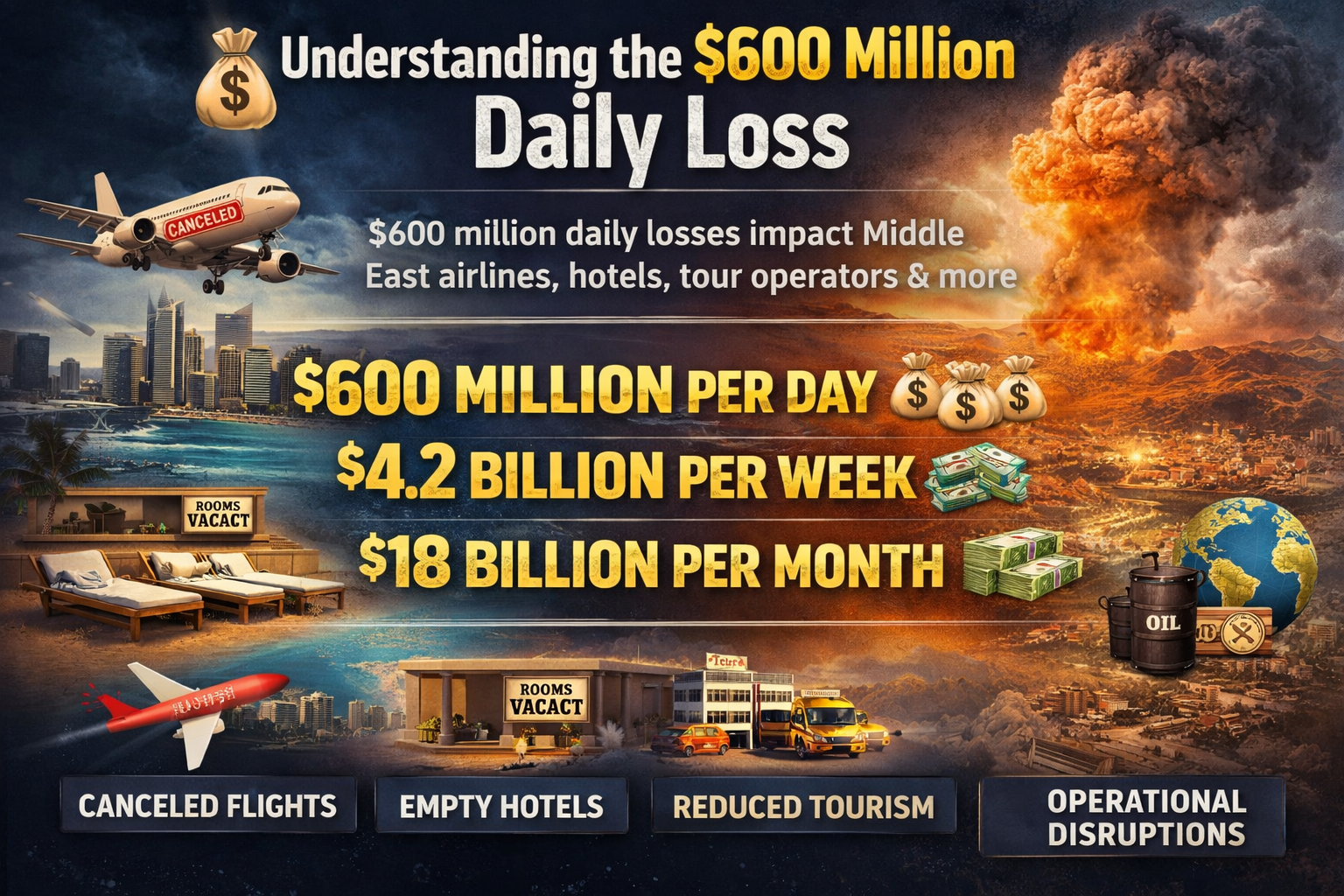
💰 Understanding the $600 Million Daily Loss
The estimate of $600 million in daily losses comes from industry analysis and projections by organizations such as
World Travel & Tourism Council. This figure represents the combined financial impact on airlines, hotels, tour operators, and related sectors.
📊 To understand the scale:
- 💸 $600 million per day equals over $4.2 billion per week
- 📅 Monthly losses can exceed $18 billion
- 📉 Annual projections could reach hundreds of billions if the conflict continues
These losses stem from reduced travel demand, canceled bookings, grounded flights, and operational disruptions across the region.
🌍 Why the Middle East Is So Heavily Affected
The Middle East plays a critical role in global aviation and tourism. Countries like
United Arab Emirates,
Qatar, and
Saudi Arabia act as major transit hubs connecting Asia, Europe, and Africa.
⚠️ Key Reasons for Heavy Impact:
1. Global Transit Hub Disruption
Airports such as Dubai International and Hamad International are among the busiest in the world. Millions of passengers rely on these hubs for connecting flights.
When conflict affects airspace:
- ✈️ Flights are rerouted or canceled
- ⏱️ Travel times increase
- 💰 Operational costs rise
👉 This directly reduces passenger traffic and revenue.
2. Airspace Closures and Flight Cancellations
One of the most immediate impacts of the Iran conflict is the restriction of airspace in sensitive regions.
Airlines are forced to:
- 🚫 Avoid certain routes
- 🛫 Take longer flight paths
- ❌ Cancel flights altogether
This leads to:
- ⛽ Increased fuel costs
- 📉 Reduced flight frequency
- 😟 Loss of customer confidence
Major international carriers are also affected, not just regional airlines.
3. Decline in Tourist Confidence
Tourism is highly sensitive to safety perceptions. Even if certain areas are not directly affected by conflict, travelers often avoid entire regions due to fear.
Current traveler behavior shows:
- ❌ Massive booking cancellations
- ⏳ Postponement of trips
- 🌍 Shift toward safer destinations
As a result, destinations like Dubai, Abu Dhabi, and Doha are seeing a noticeable drop in tourist arrivals.
4. Hotel and Hospitality Industry Losses
Hotels are among the hardest-hit sectors.
Impacts include:
- 🏨 Low occupancy rates
- ❌ Increased cancellations
- 📉 Reduced average room rates
Luxury hotels, which rely heavily on international tourists, are facing significant revenue declines.
5. Tour Operators and Travel Agencies
Travel agencies and tour operators are experiencing:
- 💸 Refund requests
- ❌ Booking cancellations
- 📉 Reduced inquiries
For businesses dependent on Middle East tourism packages, this situation is extremely challenging.
Economic Chain Reaction
The tourism industry is interconnected with multiple sectors. The decline in travel demand creates a domino effect.
Industries Affected:
- Aviation
- Hospitality
- Retail and shopping malls
- Transport services (taxis, rentals)
- Entertainment and events
For example:
A single tourist trip includes spending on flights, hotels, food, shopping, and local transport. When that trip is canceled, all these sectors lose revenue simultaneously.
Impact on Airlines
Airlines are among the biggest losers in this situation.
Key Challenges:
- Increased operational costs due to rerouting
- Reduced passenger demand
- Flight cancellations
Even global airlines outside the Middle East are affected because:
- Many routes pass through the region
- Connecting flights are disrupted
Impact on Global Travel Prices
The conflict is also influencing global travel costs.
Effects:
- Airfare prices are increasing
- Travel insurance costs are rising
- Fuel prices are fluctuating
This impacts travelers worldwide, including those in India.
Role of World Travel & Tourism Council
The WTTC has highlighted that the Middle East was expected to generate over $200 billion in tourism revenue annually before the conflict.
However, due to current disruptions:
- Growth projections have slowed
- Recovery timelines are uncertain
- Investor confidence has weakened
Real-Life Example of Loss
To understand the situation practically:
Imagine:
- 1 million tourists cancel trips to Dubai
- Average spending per tourist = $1000
Total loss:
= $1 billion from just one segment
Now multiply this across multiple countries and industries — this is how the $600 million daily loss figure becomes realistic.
Impact on Indian Travelers and Businesses
India has strong travel connections with the Middle East.
Effects on Indians:
- Flight ticket prices may increase
- Visa processing delays
- Reduced job opportunities in travel sector
For travel businesses like agencies:
- Decreased bookings
- Customer hesitation
- Financial pressure
Long-Term Risks
If the conflict continues, long-term consequences may include:
1. Shift in Global Travel Routes
Airlines may permanently alter routes, affecting Middle East dominance.
2. Decline in Tourism Investment
Investors may hesitate to fund new tourism projects.
3. Increased Competition from Other Regions
Countries in Southeast Asia and Europe may attract diverted tourists.
Possible Recovery Scenario
The tourism industry is known for its resilience.
Recovery depends on:
- Stability in the region
- Restoration of safe airspace
- Improved traveler confidence
Historically, tourism rebounds quickly once conditions stabilize.
Positive Factors for Recovery
Despite current challenges, several factors support future recovery:
- Strong infrastructure in the Middle East
- High demand for international travel
- Government support for tourism sectors
- Global connectivity advantages
Risk Factors
However, risks remain:
- Ongoing geopolitical tensions
- Fuel price volatility
- Travel restrictions
- Changing traveler behavior
Future Outlook
Experts believe that if the situation stabilizes within a short period:
- The industry could recover within months
- Demand may surge due to pent-up travel interest
However, prolonged conflict could lead to deeper economic damage.
Final Conclusion
The Iran conflict has created a significant disruption in one of the world’s most important travel regions. With estimated losses of $600 million per day, the Middle East tourism industry is facing a serious economic challenge.
This situation highlights how sensitive global travel is to geopolitical instability. While the industry has the potential to recover quickly, the speed of recovery will depend entirely on how soon peace and stability return to the region.
For travelers, businesses, and governments alike, this serves as a reminder of the interconnected nature of the global economy and the importance of stability in sustaining growth.
Key Takeaway
👉 The Middle East tourism industry is currently losing billions due to the Iran conflict, primarily because of reduced travel demand, flight disruptions, and declining tourist confidence.
👉 However, with the right conditions, the sector has strong potential to bounce back.