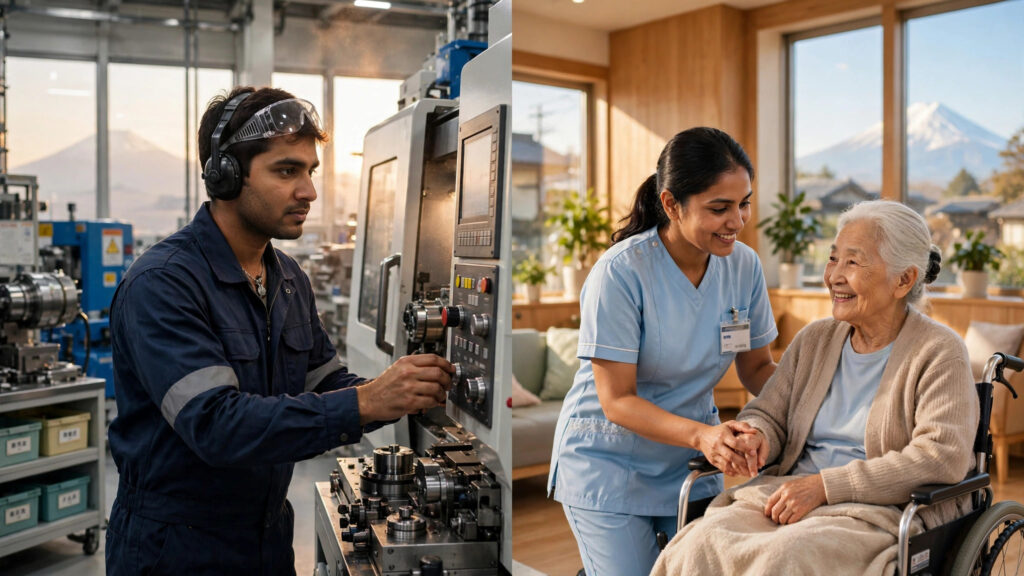
Japan’s labour shortage has made its Specified Skilled Worker (SSW) visa one of the most genuine legal routes for Indians — no university degree required. Japan SSW visa jobs suit technicians, caregivers, factory workers and hospitality staff who can prove Japanese language ability and pass a skills test. This guide covers eligibility, the language rule, the 16 sectors, the apply process and fake-offer red flags.
What Is the Japan SSW Visa?
The Specified Skilled Worker visa was created by the Government of Japan for industries facing urgent shortages. Unlike traditional Japanese work visas, the SSW route demands hands-on ability — Japanese language plus a sector-specific skills test — rather than academic qualifications. India is an approved partner country, so Indians can apply through authorised recruiters or Japanese employers.
Two levels exist:
- SSW Type 1: tested skills, stay up to 5 years (renewable). You cannot bring family.
- SSW Type 2: advanced skills and proven experience, unlimited renewals, family can join. Most candidates enter through Type 1 and upgrade later.
Eligibility for Japan SSW Visa Jobs
You must meet these government-set conditions:
- Age 18 or older. No official upper age limit, though physically demanding roles favour younger candidates in practice.
- Japanese language: JLPT N4 or above, or the JFT-Basic test (A2 level or above). Nursing care needs an additional sector-specific Japanese test.
- Skills test: pass the examination for your chosen industry. Technical Intern Training (ii) graduates in the same field are generally exempt from both tests.
- Good health confirmed by medical examination.
- Clean background — no criminal record, no deportation history from Japan.
- A signed job offer from a registered Japanese employer.
The 16 Sectors Covered by the SSW Visa
| Group | Fields |
|---|---|
| Care and services | Nursing care, building cleaning, accommodation/hotels, food services |
| Manufacturing | Industrial machinery, electronics, material processing |
| Construction and transport | Construction, shipbuilding, automotive maintenance, automobile transport, railways |
| Primary and others | Agriculture, forestry, wood industry, aviation, food and beverage manufacturing |
Nursing care (caregiving) and factory work offer the most openings for Indians, since employers there struggle hardest to recruit domestically. Note that nursing care, automobile transport, railways, forestry and the wood industry are limited to SSW Type 1.
How to Apply: Step by Step
- Choose your sector from the 16 fields, matching your skills or training willingness.
- Learn Japanese to N4 level — the real gatekeeper. Start a proper JLPT N4 course; exams run in Indian cities including Delhi, Mumbai, Chennai, Bengaluru, Hyderabad, Ahmedabad and Kolkata.
- Pass the skills test for your industry through the authorised testing body.
- Secure a job offer only from registered Japanese employers or authorised recruiters. Vague offers with no company details are a red flag.
- Certificate of Eligibility (CoE): your employer in Japan applies for it. This is the employer’s job — never pay anyone for a CoE.
- Apply at the Japanese embassy/consulate in India with the CoE.
- Fly and register — complete residence registration with support from your employer’s Registered Support Organization.
Salary Picture — Keep Expectations Realistic
SSW salaries vary by sector and prefecture, and advertised figures change with each recruitment round. Treat every advertised number as indicative and insist on seeing the written contract — it must state your exact monthly wage, hours and benefits before you sign. Never hand a large “placement fee” to anyone promising a Japan job; genuine employers do not sell jobs. If you are comparing Gulf options, see our Qatar hospitality jobs guide and the Gulf jobs medical test process.
Sunlight Holidays se apply karein — Payment After Visa model, bhaari advance nahi, pehle bharosa.
Frequently Asked Questions
Q1. Do I need a degree for Japan SSW visa jobs?
No. The SSW route is designed for workers without a university degree — language ability (JLPT N4 or equivalent) and a skills-test pass are what matter.
Q2. How much Japanese must I learn?
At minimum JLPT N4 or JFT-Basic (A2) — enough for everyday and workplace communication. Nursing care has an extra sector test; N3/N2 improves options.
Q3. How long does the process take?
Usually one to three months from a complete application, depending on documents, employer processing and embassy workload.
Q4. Can I bring my family?
Not on SSW Type 1. Family sponsorship opens only after upgrading to SSW Type 2.
Q5. Can women apply?
Yes — open to all genders, with strong demand in caregiving, hospitality and food services.
📞 Sunlight Holidays se baat karein
Visa, tour package ya videsh job se judi kisi bhi jaankari ke liye WhatsApp karein: 9720 3449 39
💰 Payment After Visa model — bhaari advance nahi, pehle bharosa.
📝 Consultation/Application fee: ₹799 (non-refundable, kaam shuru hone ke baad)
⚠️ Disclaimer: Sunlight Holidays ek travel consultancy hai — hum sarkar, embassy ya immigration department nahi hain. Visa approval, fees, processing time aur final faisla sambandhit embassy/sarkari authority ka hota hai. Kripya antim nirnay se pehle official embassy/government website se latest jaankari verify zaroor karein.